



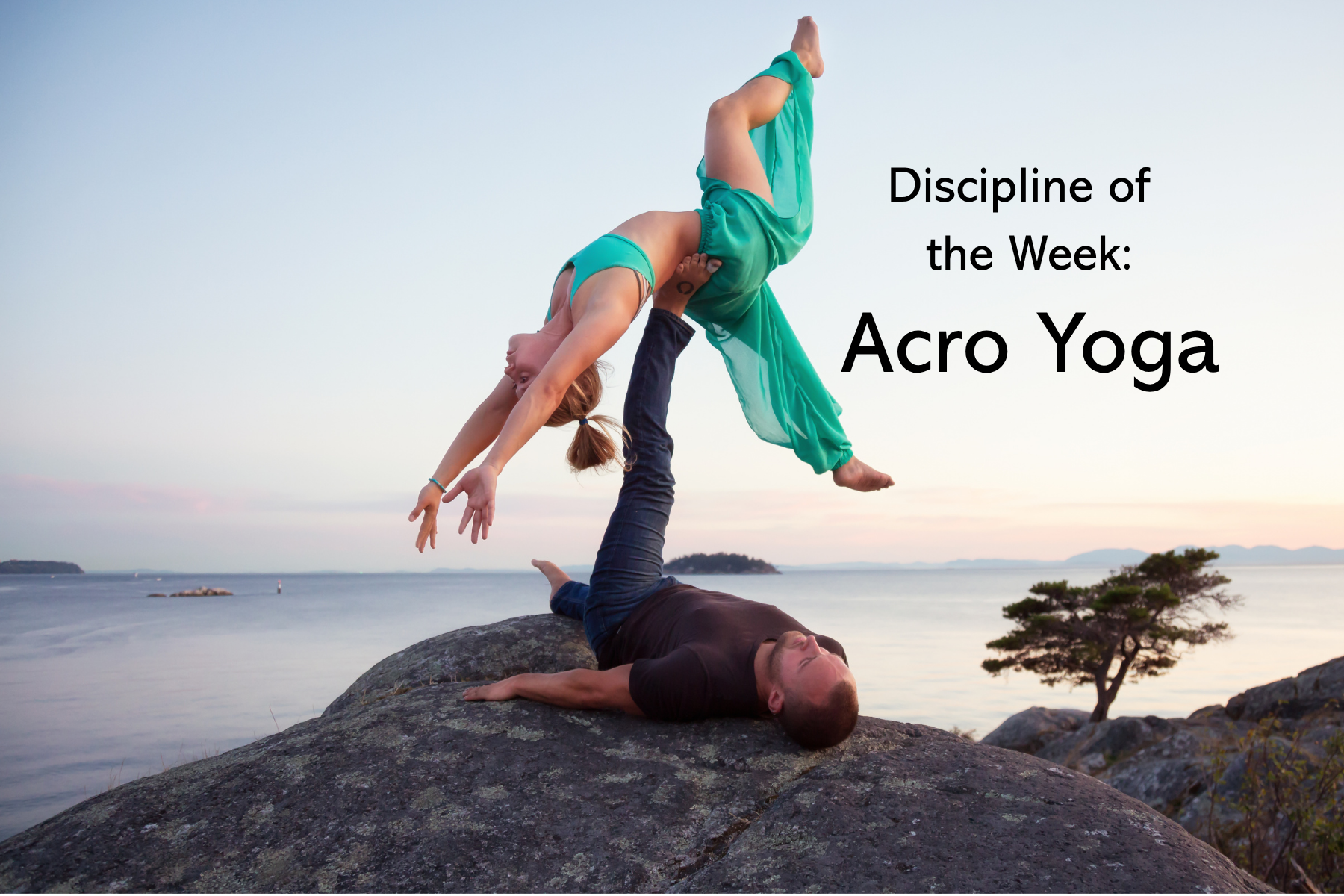
Discipline of the Week: Acro Yoga
Discipline of the Week: Acro Yoga
Strength meets trust. Balance meets connection.
Acro Yoga combines partner acrobatics and yoga-inspired movement. A typical practice involves a base, who provides support, and a flyer, who moves and balances above and around the base.
With communities found around the world, Acro Yoga has become one of the most widely practiced and recognizable forms of partner acrobatics globally. At its core, it’s about communication, trust, balance, and creating movement together.
Where Did Acro Yoga Come From?
While partner acrobatics and therapeutic movement have much older roots, modern Acro Yoga began taking shape in the 1980s and 1990s, building on practices such as Contact Yoga and AcroSage.
The discipline developed through multiple lineages. In Montreal, Eugene Poku and Jessie Goldberg combined acrobatics, dance, and yoga, using the term AcroYoga by 1999. In California, Jason Nemer and Jenny Sauer-Klein developed their own practice beginning in 2003, helping formalize and spread AcroYoga internationally.
Today, Acro Yoga continues to evolve through workshops, festivals, jams, and communities around the world.
The Two Main Foundations: L-Basing & Standing
L-Basing
In L-basing, the base lies on their back with their legs raised, creating an “L” shape. The base’s feet and hands become the major points of support for the flyer.
L-basing forms the foundation for many Acro Yoga poses and flows, and partners can link multiple positions together into continuous sequences. These sequences allow partners to move smoothly from one position to another without returning to the ground between each movement.
Standing Acro
In Standing Acro, the base remains upright while supporting the flyer through primarily the hands, arms, and shoulders, although the thighs and torso are definitely utilized as well.
Standing practice requires significant strength, balance, coordination, and body awareness and can involve hand-to-hand balances, foot-to-hand positions, transitions, and dynamic partner movement.
From Therapeutic to Dynamic
One of the most interesting things about Acro Yoga is its range.
Some practices focus on therapeutic flow—slow, supported movements that incorporate stretching, relaxation, and connection. Others explore highly dynamic sequences involving everything from high paced transitions to flips.
Whether gentle or dynamic, the foundation remains the same: two or more people communicating with their bodies as acrobats to create shape and movement.
Why Acro Yoga?
Acro Yoga turns movement into something shared. The flyer trusts the base, the base responds to the flyer, and the spotter helps create a safe environment for exploration.
It’s a physical practice, but it’s also a practice in communication, trust, awareness, and connection—which may be why it has developed such a strong global community.
Join the Global Network of Acrobats and Find an Acro Yoga community (or add yours!)
Ignite. Unite. Take Flight.
#acroessence #acroyoga #acro #partneracro #acrocommunity